
EU Job Architecture in Minutes, Not Months: Introducing our Job Profile Library

SkillsTrust
• 4 minute read

This week we launched our Job Profile Library, currently in beta. It includes 100+ expert pre-scored job profiles, built on the EU point-factor method. Instead of scoring every job from scratch, employers can put together a first version of their job architecture in minutes, not months and then customise it for their business. We’d love for you to try it out and let us know what you think.
Here's why we built it.
In a past blog, we shared our analysis of the European Institute for Gender Equality (EIGE) guidelines for job evaluation.
The bottom-line is that these guidelines, which were published in March 2026, are a good thing for EU employers. They provide much-needed clarity on building compliant job architecture for EU Pay Transparency, and they offer an open-source alternative to the expensive proprietary job evaluation methodologies offered by incumbent providers.
The Guidelines Are Useful but Implementing them Manually Is Painful.
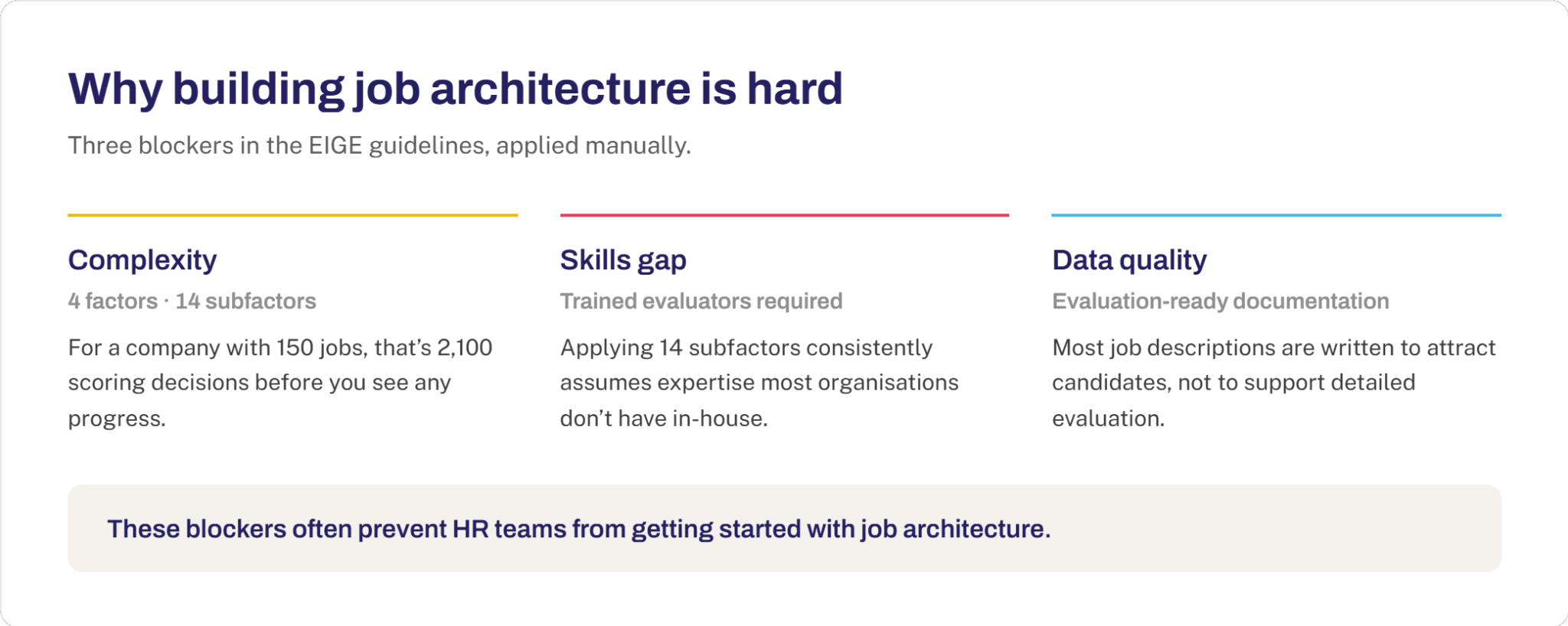
However, the guidelines let employers down in several ways. The level of effort, complexity, and pre-existing documentation required to implement these guidelines manually is unrealistic for most companies. The three biggest blockers we see across companies managing this work are:Complexity. Scoring a job across 4 factors and 14 subfactors is a project in itself. A company with 150 jobs, scoring each across 14 subfactors will need to make 2,100 scoring decisions.
Skills gap. Applying those 14 subfactors consistently assumes trained job evaluators, which most organisations don't have in-house.
Data quality. Scoring assumes detailed, standardised job documentation is available. Most job descriptions are written to attract candidates, not to support this kind of detailed evaluation exercise.
That implementation barrier is a problem, and the EIGE guide does not have a lot of answers that don’t involve endless back and forth with multiple stakeholders.
EU pay transparency has the potential to close the gender pay gap but only if it's easy for employers to implement. Our mission at SkillsTrust is to make pay transparency as simple, fast, and affordable as possible. In the past, the issues above have stood in the way.
How the Job Profile Library is Designed to Help
This week's launch of the Job Profile Library is a big step toward that mission. It's built on what we've learned helping dozens of companies build job architecture across a range of industries. Our aim is to get employers past the blockers that stop them from getting started:
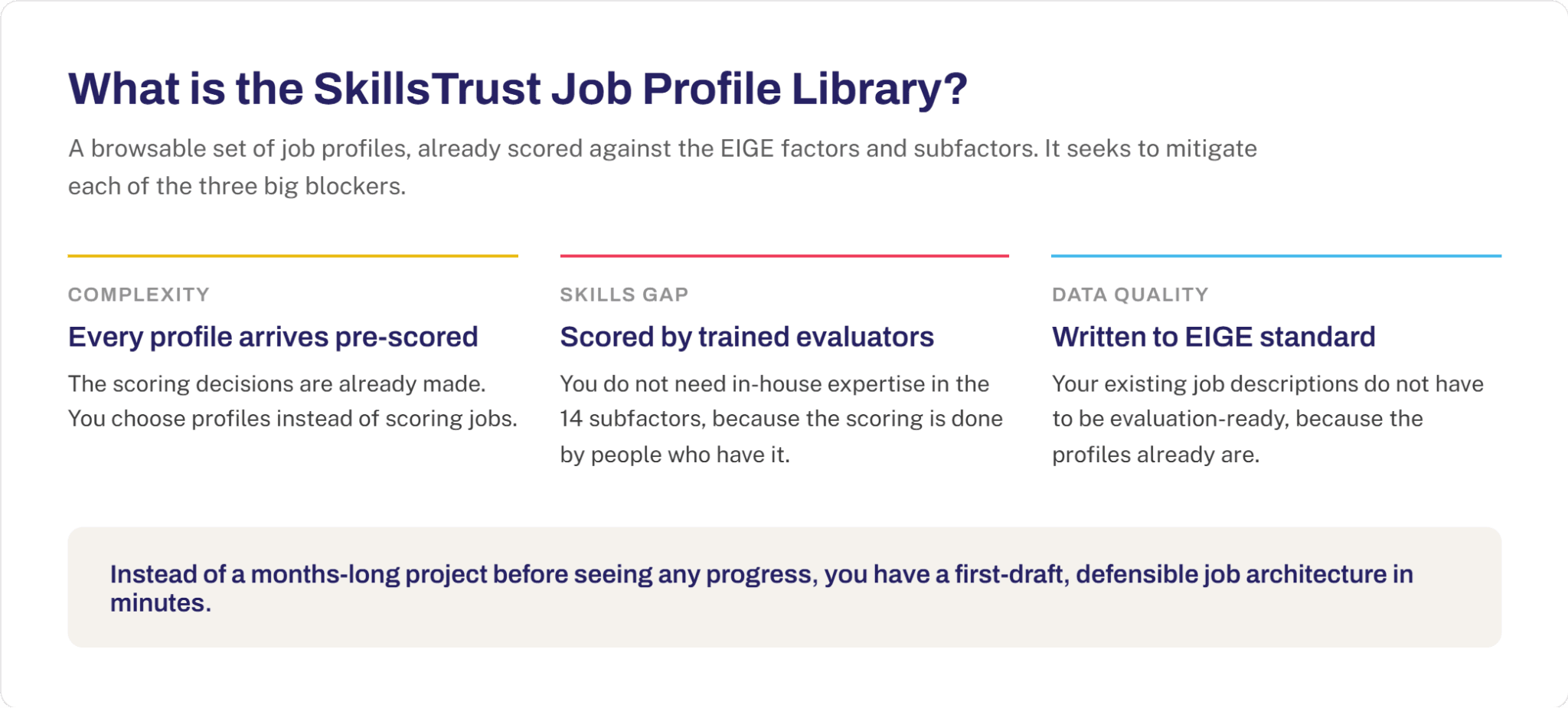
Minimising complexity: Every profile arrives pre-scored, so you're choosing from a set of jobs rather than scoring them yourself.
Evaluated by Experts: The library's profiles are scored by people who do have that expertise, so you don't need it on your own team to get started.
High Quality Job Profiles: The library's job profiles are already written in the EIGE-recommended format, so your own job descriptions don't need to be evaluation-ready first.
The result: instead of a months-long project before seeing any progress, you have a first-draft, defensible job architecture in minutes.
How to build your job architecture in minutes.
The free version of the library lets you search and browse pre-scored job profiles, then add up to 20 profiles to build out your own job architecture. Once you're happy with it, download the full architecture — including the job group and subfactor scores of every job — or email it straight to your inbox. If a Job you need isn't in the library yet, you can request it directly, and we'll add it to the queue.
Our recommendations on where to start.
A simple way to start building a job architecture is to pick a representative subset of jobs to act as your anchors. These jobs should reflect a cross section of your organisation. We suggest including:
Your most senior and most junior jobs, to set the top and bottom of the points range.
Your highest-headcount jobs, since they affect the most employees.
A spread across job families and seniority levels, to fill out the picture in between.
Search each one in the library, add it to your job architecture using the purple ‘Add to Job Architecture’ button. 10-15 well-chosen anchor jobs is a good place to start.

In a few minutes, you'll have a first-draft job architecture covering the shape of your whole company, without having scored a single job yourself.

If you want to keep building, the paid version of the software lets you edit and re-score profiles to match your organisation exactly, collaborate with your team on reviews with a full audit trail, and connect your job architecture to your payroll data to run a pay gap report.
Job architecture projects don’t need to sink your team's time. With the right tools, a previously overwhelming project becomes much more manageable.