
What Goes Into an EU Pay Gap Report | Pay Gap Analytics 101

SkillsTrust
• 4 minute read

An EU pay gap report needs employee-level data, gender, job title, job category and entity, covering a full calendar year of pay. From there, you calculate mean and median gaps, variable pay participation, and quartile distribution at company and job category level. The report then needs sign-off before it's published to your national equality body and, in part, to your employees and the public.
If you're getting ready for your first report, you will need to answer these three questions:
Is my company eligible for reporting?
When do I need to report?
What goes into an EU Pay Gap Report?
Is your company eligible for reporting?
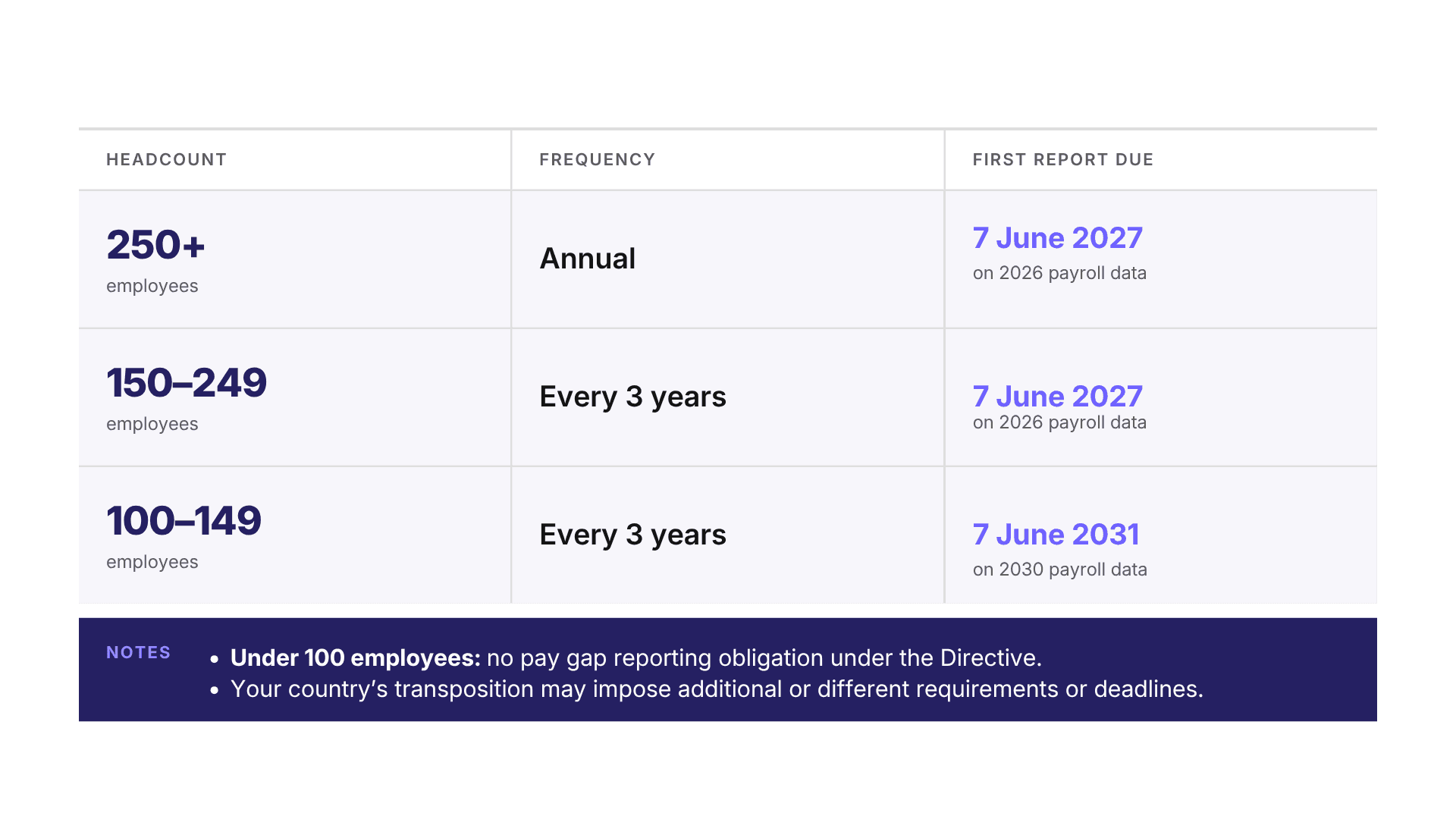
The first thing to understand about EU Pay Transparency is that while every company has some obligations, not every company has reporting obligations. Your headcount decides if and when you need to report. If you have 100-149 employees, you can expect to be in scope for EU pay gap reporting every 3 years starting June 2031. If you have over 150 employees, you're in the first wave of companies expected to report in June 2027.
Make sure to check your own country's national reporting thresholds, as they can differ from the EU Directive’s outline. As of time of writing, Spain and Portugal’s draft legislations extend down to companies with 50+ employees. Many other EU member states could follow.
When do you need to report?
Not all companies need to report on the same schedule. As mentioned already, smaller companies (100-150) are expected to report on a 3-year cadence, starting June 2031 reporting on 2030 pay data. For companies in the 150-249 group, while the start date is sooner (June 2027 reporting on 2026 pay data), that group will also be reporting on a 3-year cadence.
Companies with 250+ will have to report annually starting June 2027 (reporting on 2026 pay data). As always, each jurisdiction can give its own guidance on who is eligible for reporting and when they need to report. Make sure to check your local guidance as we have already seen some jurisdictions come up with their own reporting timelines. For example, companies in Slovakia, the first EU member state to implement the Directive, have employers submitting their first report by June 2027, then shifting to April 15th for every report after that.
What goes into an EU Pay Gap Report?
To understand what goes into an EU Pay Gap Report, we need to answer:
What data do I need?
What metrics do I need to calculate?
What needs to be published?
What data do you need?
Collecting the right pay data is the hardest part of the report. Once you have the right data in place, running the calculations and publishing is smooth sailing.
For each employee, you need:
Their gender
Job title
Job category (see our blog on job categories here)
Location
Entity
Then you need a full calendar year of payroll data. That means every pay element: basic pay, variable cash like bonuses, overtime and shift premium, benefits in kind, and employer pension contributions.
This information needs to come from your payroll system, not your HRIS system.
Reports are built on a jurisdiction by jurisdiction basis, so if you have 100+ employees in multiple EU member states, you'll be tracking separate thresholds, deadlines, and requirements for each one.
Cleaning data is often the most time consuming part of reporting, so it helps to have a great analyst dedicated to it on your team. If you don’t, this is exactly the kind of thing we help SkillsTrust customers with.
What metrics do you have to calculate?
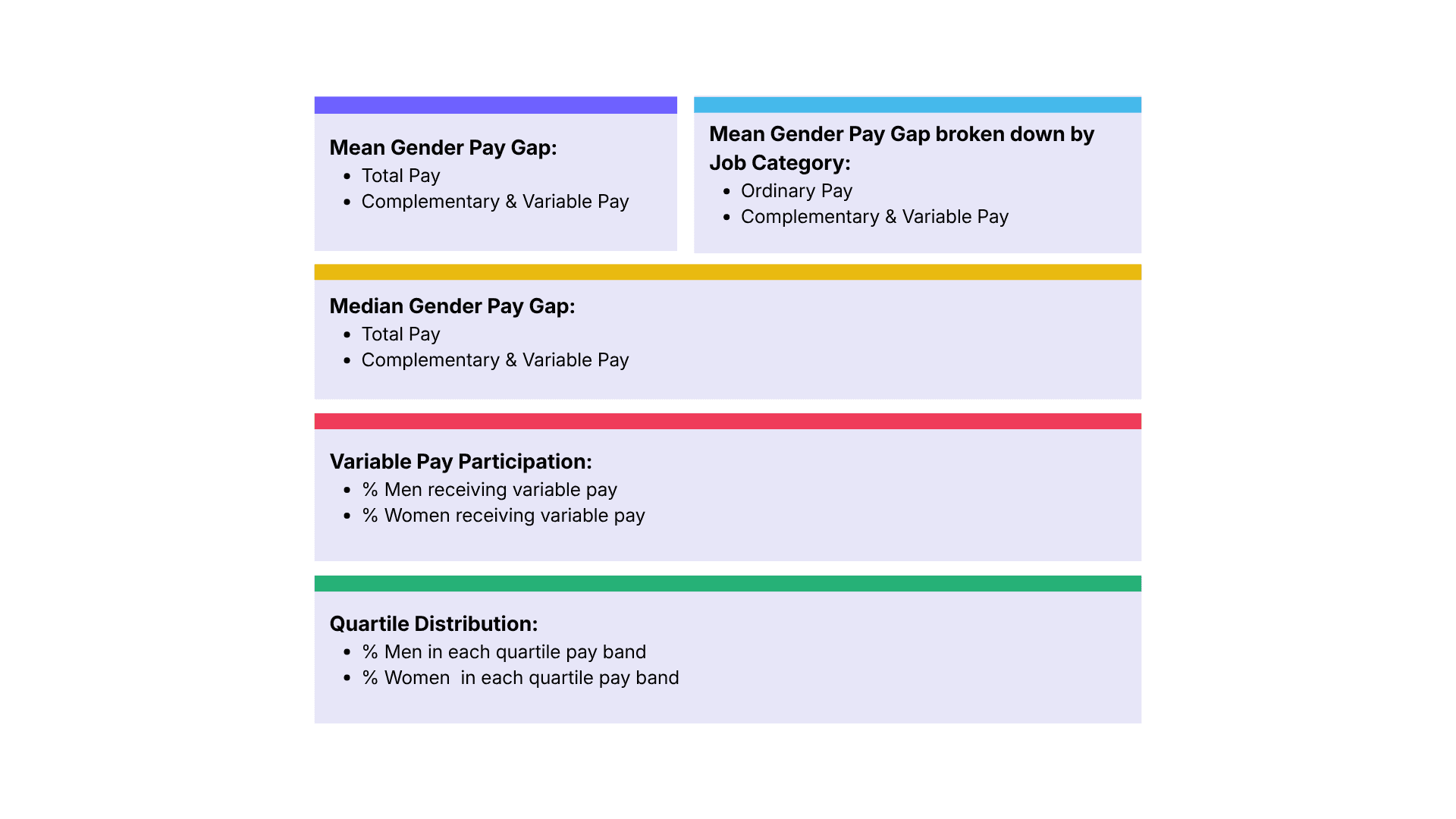
There are 10 metrics you need to calculate in total, once you count each one split by pay type and gender.
The mean gender pay gap, for total pay and separately for complementary and variable pay, at company level and broken down by job category.
The median gender pay gap, again for total pay and separately for complementary and variable pay.
Variable pay participation rates, meaning the percentage of men and the percentage of women who actually receive variable pay.
The quartile distribution, meaning the split of men and women across your top to bottom pay bands.
What needs to be published?
There are two types of publishing you need to do with your EU Pay Gap Report. Internal reporting to your employees and external reporting to your national equality body.
Your company level pay gap, along with your median and quartile figures need to be published externally.
Your category level pay gaps do not need to go in the external report, but rather an internal report to employees. This style of reporting does not guarantee full privacy, but the category-level pay gaps do not need to appear in your public disclosure.
Before anything is published, internally or externally, employee representatives need to be consulted. Management also needs to sign off the report before it goes to your national equality body.
Building an EU Pay Gap report does not need to be intimidating. Once you know your reporting obligations and schedule and have the right data in place, running the numbers should be straightforward. However, having the numbers is one thing. Knowing whether a pay gap in your data is a real problem or has an objective, gender-neutral explanation is a different question, and that's what we'll dive into in our next blog.