
Understanding & Triaging Your Pay Gaps | Pay Gap Analytics 101

SkillsTrust
• 4 minute read

Our most recent piece covered what goes into an EU Pay Gap Report: the data, the calculations, and what gets published.
Having the pay gap numbers is one thing. Understanding what they mean is another. In this piece, we look at how to interpret your company-level pay gap first, then how to dig into any category-level gaps of 5% or more (the threshold set by the EU Pay Transparency Directive) and work out whether a gap is justified or needs remediation. We recommend a simple 5-step process you can use to identify which employees need a detailed pay review as part of diagnosing category-level pay gaps. As always, this is written for small HR teams without a dedicated Rewards function.
What's driving your company’s pay gap?
Two different factors can drive the company-level gender pay gap:
Representation
Equal Pay Dynamics.
It’s important to look at the impact of each as they require different fixes.
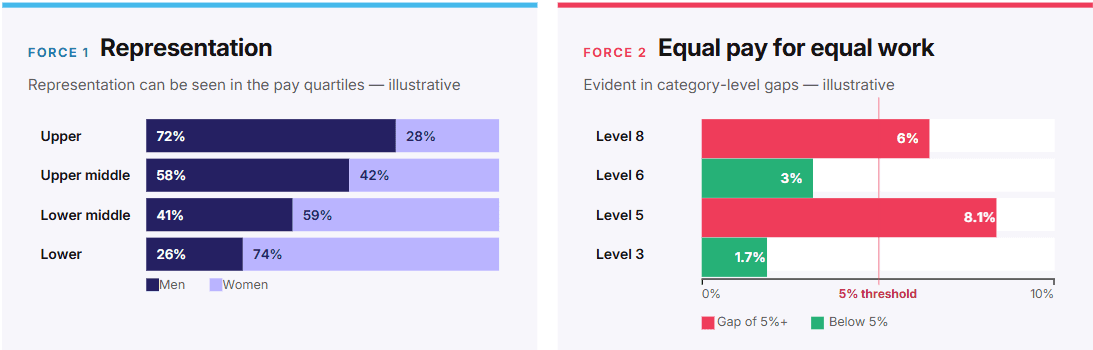
Representation as a driver of the pay gap. If women make up a very small percentage of your top earners, you'll see a pay gap even if there is equal pay for equal work between men and women doing like work. The impact of representation can be seen in your pay quartile data, the split of men and women in each quartile of your pay distribution. A pattern like 72% men and 28% women in your top pay quartile, narrowing to 26% men and 74% women in your bottom pay quartile, will produce a significant company level pay gap, even if there is pay parity between men and women in the same job category. Tackling representation as a driver of the pay gap is about intentional hiring, retention and progression policies and working to ensure even representation across the best-paying and least-well-paying jobs.
Equal Pay Dynamics. The second driver of the pay gap is equal pay for equal value (i.e. the pay gap between men and women performing work in the same job category). This is the primary focus of the EU Pay Transparency Directive. Specifically, the Directive requires that a pay gap of 5% or more within any job category must either have an objective justification or be remediated. The rest of this article will focus on a process you can follow to determine whether there is objective justification for a category-level gap of 5% or more.
How to tell if a category-level pay gap of 5% or more is justified?
If you're not running a large comp team with dedicated software, here's a manual 5-Step Process of Elimination you can use.
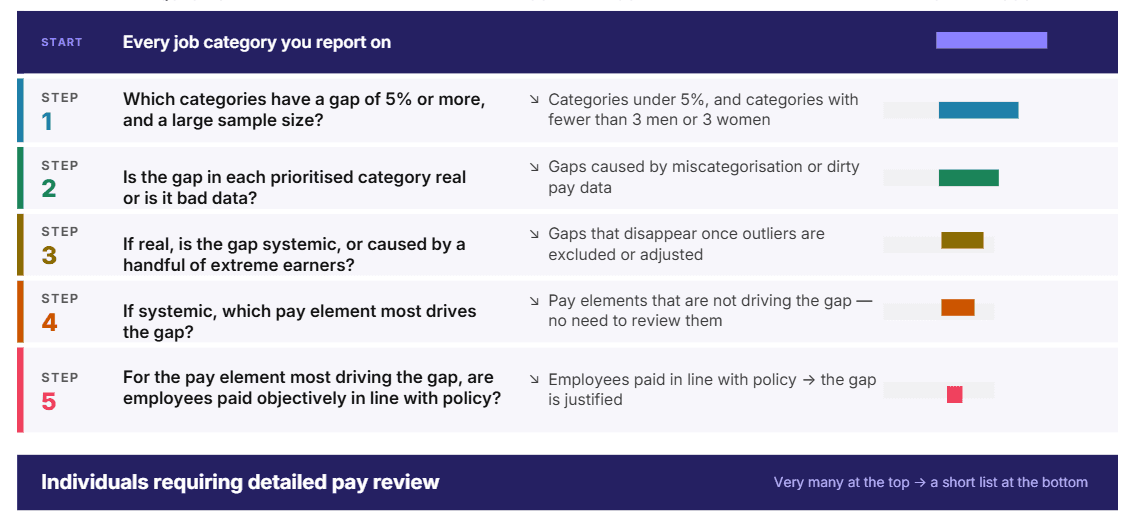
Step one: prioritise categories by headcount. Look at every job category with a gap of 5% or more. Rank the job categories by number of employees affected, largest to smallest, and start your review with the largest. As a rule of thumb, categories with fewer than three men and three women should be set aside and reviewed separately, since very small samples like this are naturally prone to distortion.
Step two: data quality test. Before assuming there's a problem, check for two common causes. The first is poor pay data quality, most commonly an employee's hours not being adjusted to reflect a partial year, or an unflagged period of long-term sick or parental leave, either of which can make someone's pay look artificially high or low. The second is potential job architecture quality issues, where roles that aren't actually equal in value have been mis-grouped into the same category. Review and resolve any data quality issues or job architecture inaccuracies before proceeding.
Step three: triage the gap by root cause. The pay gap may be systemic with most employees of one gender sitting in the lower half of the pay distribution or it may be more localised and driven by a small number of extreme earners (i.e. outliers). As a rule of thumb, we define outliers as anyone paid below 80% or above 120% of the median in their job category. Start by looking at the gender distribution within the pay range to check for clustering by gender in the lower or upper half. Then test the impact of excluding outliers or adjusting them to be within range. If the gap is resolved this way, the task becomes individual: is each outlier's pay objectively justified, or do they need to be red-circled at the high end (pay frozen until the range catches up) or adjusted upward at the low end?
If outliers aren't the whole story and the gap holds even once they're accounted for, then move on to Step four to find which pay element is actually driving it.
Step four: pay element test. For gaps that are not driven solely by outliers, next look to isolate the main driver of the gap. Look at the pay gap for total pay and then for base only, variable only, and benefits in kind (BIK) only, to determine which pay component (if any) is the primary driver. As an example, you might find that base pay sits well within the 5% threshold, but variable pay is showing a gap of over 20%. That tells you where to focus. For base pay specifically, look at both an individual's positioning within their range and whether there are pay range differences between job families sitting within the same category.
Step five: policy alignment test. Take the individuals affected by the pay component driving the gap, and check each one against your own policy: does their pay position match what policy says it should be, given their experience, tenure, or performance rating? For bonus and benefits in kind, check whether eligibility rules were applied consistently, not just documented. A gender-neutral policy, correctly applied, is your objective justification. If the policy is neutral on paper but its outcome consistently disadvantages one gender in practice, that's not a justification, it's a signal something in how the policy is being applied needs fixing.
What happens if the gap isn't justified?
By the end of this step, you should have a set of actionable findings: a category has a gap above 5%, driven by a particular pay element. Most employees are paid in line with policy but a smaller group aren't, and there's no objective reason why. That group is now your remediation target: you know exactly who they are, what it would cost to move them to their policy-aligned position, and how much that closes the category gap.
As a reminder, employers are required to either remediate this gap to below 5% within 6 months or carry out a joint pay assessment with workers' representatives, which means diagnosing the cause(s) of the gap, reviewing what's been done about it so far, and putting corrective measures in place.
Once you've worked through your data, understood what's driving your gaps, and either justified or remediated them, you're in a strong position heading into your first pay gap reporting cycle.
The process outlined here works well if you're checking a handful of small categories by hand. If you're running it for hundreds of employees, software like SkillsTrust can automate the steps so you get the insights you need faster.
Book a demo to see how it works.