
EU-wide guidelines on gender-neutral job evaluation: A Business View on What’s Helpful and What’s Not

SkillsTrust
• 4 minute read
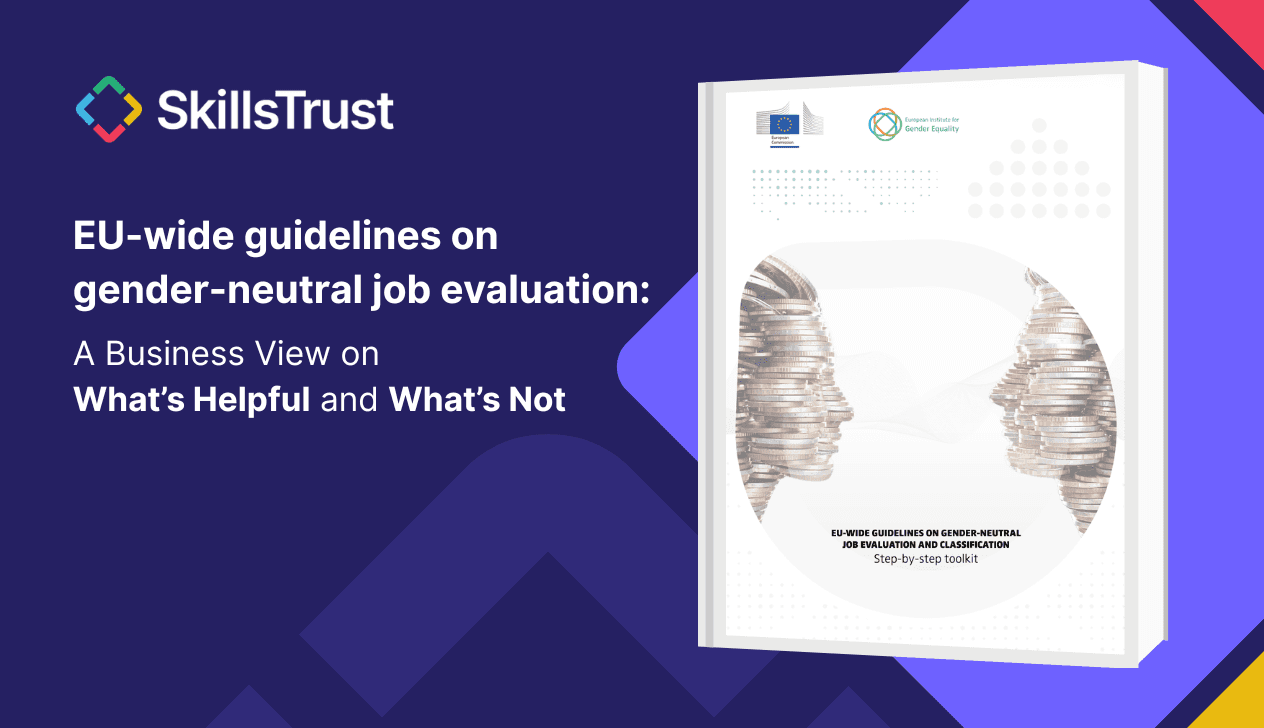
EU-wide guidelines on gender-neutral job evaluation: A Business View on What’s Helpful and What’s Not
Almost three years after its approval, the EU Pay Transparency Directive is moving towards implementation but the exact timing remains unclear, as many member states have yet to transpose it into national law.
Despite this uncertainty, employers are under growing pressure to prepare. One of the most challenging aspects has been job categorisation: what compliant job categories should look like in practice, and how organisations are expected to implement them.
Some clarity finally arrived on March 27th with the publication of EU-wide guidelines on gender-neutral job evaluation by the European Institute for Gender Equality (EIGE), endorsed by the European Commission.
The question now is whether these guidelines are practical for employers - or whether they assume a level of time, resource and administrative effort that many organisations simply don’t have.
This article looks at what the guidelines get right, where they fall short, and what this means in practice for employers.
Overview of the Guidelines
The guidelines offer three different job evaluation approaches based on company size:
Micro companies (<10 employees)
Small & Medium companies (up to 250 employees and <15 jobs)
Large companies (>15 jobs)
Here, I focus on large companies, as in practice, most organisations have more than 15 jobs.
What’s Helpful
The EIGE Guidelines provide welcome clarity by aligning behind a standardised approach to job evaluation. For large companies, the guidelines endorse the use of a point-factor methodology with predefined factor definitions, subfactors, scoring scales, weights and formula. For many organisations - particularly those without in-house rewards expertise - getting access to this kind of clear structure is genuinely helpful and removes a significant amount of guesswork.
More broadly, it reinforces sound principles: that jobs should be evaluated in a structured way across multiple dimensions, that job documentation matters, and that validation of scoring by multiple stakeholders is necessary.
Where It Falls Short
Timing. The toolkit suggests the job evaluation process will take around six months to implement, yet it was published less than three months before the Directive is due to come into force. In reality, job evaluation projects often take significantly longer - according to Deloitte’s annual job architecture survey, often up to two years - placing many employers in a pressurised position.
Complexity. The complexity of the framework is another major challenge. Each job is assessed across 4 factors (skills, effort, responsibility and working conditions), with 14 subfactors beneath them. This scales quickly. For a company with 150 jobs, this results in 2,100 individual scoring decisions. When five evaluators are involved (as suggested), this rises to over 10,000 scores that must then be set, reviewed, discussed and aligned.
Skills Gap. The expectations around evaluator capability also add friction. The toolkit assumes that evaluators can be trained to apply 14 subfactors consistently and objectively across all jobs. In reality, many organisations do not have in-house job evaluation expertise, and achieving consistent interpretation of scoring criteria across multiple evaluators is itself a non-trivial exercise particularly under time pressure.
Validation burden. Crucially, the burden is not just in scoring - but in validation. The prescribed approach requires each evaluator to assess all jobs independently before reconciling differences through structured calibration sessions. In practice, this creates a coordination challenge as much as an analytical one: aligning five stakeholders across hundreds of jobs requires repeated workshops, detailed justifications, and documentation of decisions. This level of involvement is difficult to sustain alongside day-to-day business responsibilities.
Data Quality. There is also a significant dependency on high-quality, standardised job documentation. The methodology assumes that jobs are described in sufficient detail to support scoring across all factors and subfactors. In practice, job descriptions are often inconsistent, outdated, or written for hiring rather than evaluation purposes. This creates an additional upfront workload: jobs must first be rewritten or standardised before they can even be evaluated reliably.
Tooling Gap. Finally, the tools provided - primarily Word docs and spreadsheets - do not support managing this process efficiently at scale. Version control, collaboration, and auditability very quickly become challenging, leaving organisations to design and maintain their own systems around the methodology.
All of this sits at odds with the reality in most businesses. A mid-sized company with 500 employees and 150 jobs may have an HR team of up to four people, often without dedicated Rewards expertise. The level of effort assumed by the toolkit does not reflect these constraints.
The Core Issue
The challenge is not with the underlying methodology. It makes sense to evaluate jobs across multiple dimensions, to ensure job documentation is robust, and to involve human judgment in validating outcomes.
The difficulty lies in how the process is expected to be carried out. The approach assumes a manual, highly resource-intensive way of working that feels out of step with how organisations operate today. The process as outlined by EIGE would have been carried out the same way 20 or 30 years ago as they are suggesting it be done today.
A More Practical Approach in 2026
A more realistic approach is to retain the EIGE methodology, but fundamentally rethink how it is delivered.
EIGE manual model:
Job descriptions are created and reviewed manually, with no consistent standard of quality
Five evaluators independently score every job across all factors
Differences are resolved through full reconciliation workshops
Progress is tracked across spreadsheets and documents
This approach is thorough, but difficult to execute at scale - particularly under time and resource constraints.
Tech-enabled model (EIGE-aligned):
Job descriptions are standardised and quality-checked using AI against EIGE criteria
Baseline scoring is generated based on job content
Human evaluators focus on validating, adjusting, and calibrating scores—rather than creating them from scratch
A system-generated audit trail tracks how scores evolve, flags inconsistencies, and highlights where job content does not support evaluation outcomes
This represents a shift from a fully manual process to a hybrid model where technology handles scale and consistency, and humans provide judgment and accountability.
Crucially, this is not about reducing rigour - it is about making rigour operationally achievable.
Job evaluation is not an end in itself; its purpose is to underpin defensible pay outcomes. Any approach that is too slow, inconsistent, or difficult to maintain risks undermining that objective.
Conclusion
The EIGE toolkit is a positive step in that it provides structure and clarity on an important aspect of the Pay Transparency Directive. However, in its current form, it is too complex, manual and resource-intensive for many organisations to implement, particularly given the timelines involved.
For most employers, the path forward will not be to reject the methodology, but to find practical ways of applying it - leveraging technology and modern tools to reduce the administrative burden while still meeting the intent of the guidelines.
Want to implement pay transparency in a tech-enabled way at your company? See how SkillsTrust helps HR teams operationalise pay transparency in a practical way. Chat with our team.