
One Month to Go: The EU Pay Transparency Directive Deadline Is Almost Here

Olwyn Patterson
• 4 minute read
In 2023, EU Member States voted on, and passed, the EU Pay Transparency Directive. 7 June 2026 was the date chosen for each Member State to transpose the legislation locally. And now, with one month to go, the picture looks less like a coordinated legal rollout and more like a class of college students scrambling to meet a deadline.
One has handed in on time. A few have partial submissions. One is openly weighing up whether it would rather take the penalty than complete the assignment. The rest of the class appears to be asking for extensions.
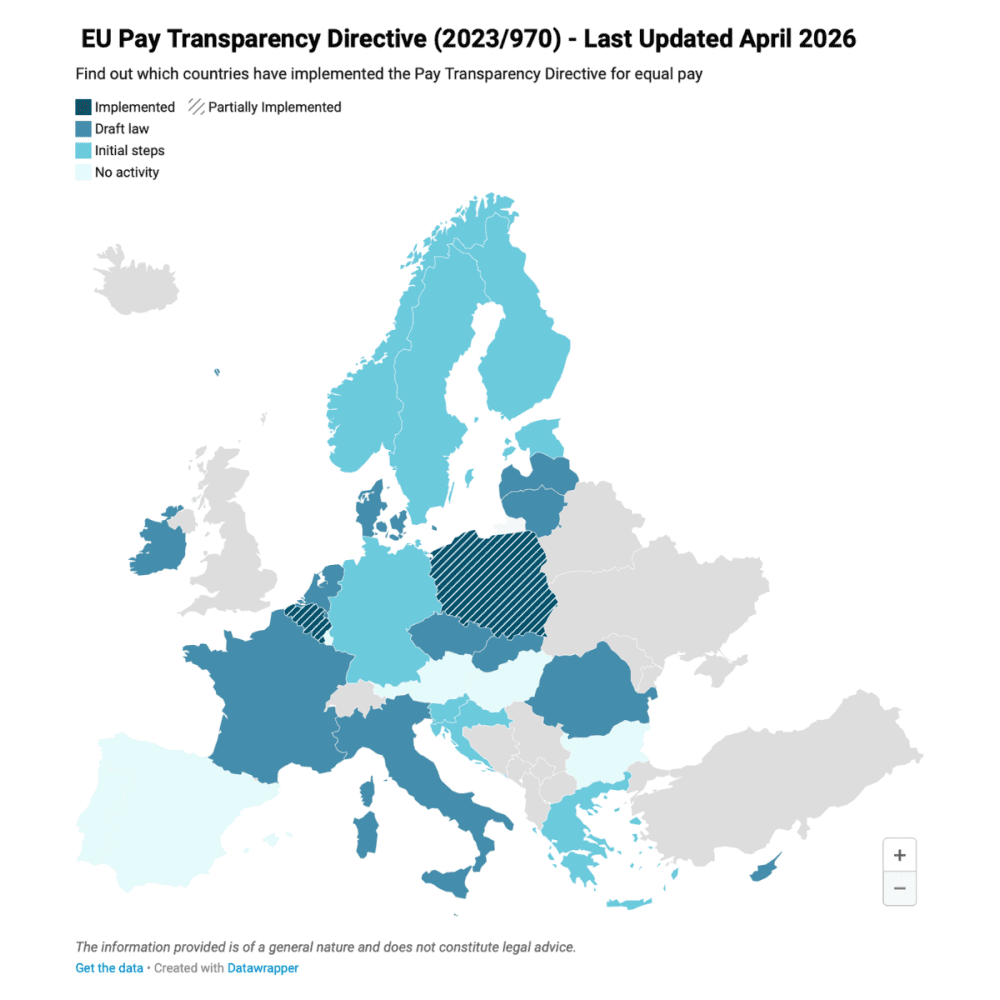
Source: Lewis Silkin EU Pay Transparency Directive Tracker
Even the law that has been transposed on time came at the eleventh hour. Slovakia, the only country so far to fully transpose the Directive into national law, adopted its Equal Pay Act on 15 April 2026, with the law coming into force on 7 June 2026. That gives employers less than eight weeks between adoption and commencement to get ready.
While we can complain about policymakers dragging their feet for the last three years, businesses should not feel paralysed by the fact that national legislation is still missing in many jurisdictions. The myth about the Directive that I believe commentators often get wrong is that this is a brand-new challenge for companies.
Yes, enforced pay transparency is a seismic shift for many employers. But the “net-new” part is the enforcement. The principles underneath it have been sitting in plain sight for decades. Article 4 requires pay structures that allow employers to assess whether workers are in a comparable situation, using objective, gender-neutral criteria including skills, effort, responsibility and working conditions. Translated out of legalese, that means having a defensible job architecture in place. Formal job evaluation has been around for a century. Merrill R. Lott introduced point-factor job evaluation in 1925, before expanding the idea in Wage Scales and Job Evaluation in 1926.
Another “not entirely new” requirement is the Article 7 right to information. While the content is now related to pay, EU companies have been handling GDPR subject access requests since 2018. The muscle memory is there: receive a request, identify the relevant data, apply a deadline, respond clearly and document the process. The Directive changes the subject matter, not the basic discipline.
In fact, an indicator of how “not new” the EU Pay Transparency Directive is comes, surprisingly, from some of its critics.
Sweden has called for renegotiation and simplification of the Directive. Estonia has also pushed back, with its economic affairs minister reportedly saying the country would rather pay a fine than increase the administrative burden on businesses.
The reasons are not identical. Estonia’s objection has been framed around bureaucracy and business competitiveness. Sweden’s position is more nuanced: it argues the Directive is too administratively burdensome in its current form and should be simplified. But Sweden is also starting from a different place. Through collective bargaining, the Swedish Discrimination Act and annual equal pay survey obligations, Swedish employers already operate within a more developed framework for discussing, documenting and assessing pay equality. These systems may not have been called “pay transparency” until now, but they have already given employers, employees and social partners a structure for engaging with pay.
And yet, even progressive countries still have work to do. Sweden remains one of Europe’s most progressive countries on pay equity reporting, but its national gender pay gap has not disappeared, sitting at 11%.
So, for companies waiting with bated breath for national transposition, what can you do in the meantime?
The answer is less dramatic than you might hope: get the basics together.
National legislation will hopefully give more detail on which specific pay components to include, local reporting formats, worker representative consultation, enforcement mechanisms and penalties. But there is already more than enough context in the Directive itself to begin preparing.
There is also now practical guidance. The European Commission and the European Institute for Gender Equality have published updated EU-wide guidelines on gender-neutral job evaluation and classification. The guidance lays out job evaluation frameworks for micro-organisations, small and medium businesses and large organisations, which employers can begin to implement right away.
In other words: employers do not need to wait for every national parliament to finish its homework before starting their own.
I think the real anxiety comes from the procrastination of not starting. The longer employers wait to begin their pay transparency projects, the longer they can avoid thinking about the proliferated job titles, inconsistent salary histories, legacy pay agreements and “we’ve just always done it this way” decisions they will eventually have to face.
Pay transparency projects are a heavy lift, especially for small and medium-sized employers that do not have in-house compensation, legal and people analytics teams. But the work does not disappear if you ignore it. It simply waits.
The good news is that once you get visibility over your company’s state of pay, the problem becomes much less mysterious. You can see what needs documenting, what needs explaining, what needs consultation and what is already fair and equitable as it is.
That last point is what really matters. Pay transparency preparation is not only about uncovering risk. It is also about giving employers confidence where their practices are already sound.
With one month to go until the EU Pay Transparency Directive transposition deadline, it’s clear that not every Member State will be ready on time. Employers should be focusing on their own readiness instead.
Because whatever happens in national parliaments over the next few weeks, the direction of travel is now clear. Pay transparency is not a future trend. It is the next compliance baseline. And the employers that start with job architecture, gender-neutral evaluation and pay equity analysis now will be in a far better position than those waiting for the bell to ring.
Olwyn Patterson leads Operations at SkillsTrust, the simple pay transparency software for EU employers.