
How to Quality Check Your Job Architecture for EU Pay Transparency

SkillsTrust
• 4 minute read
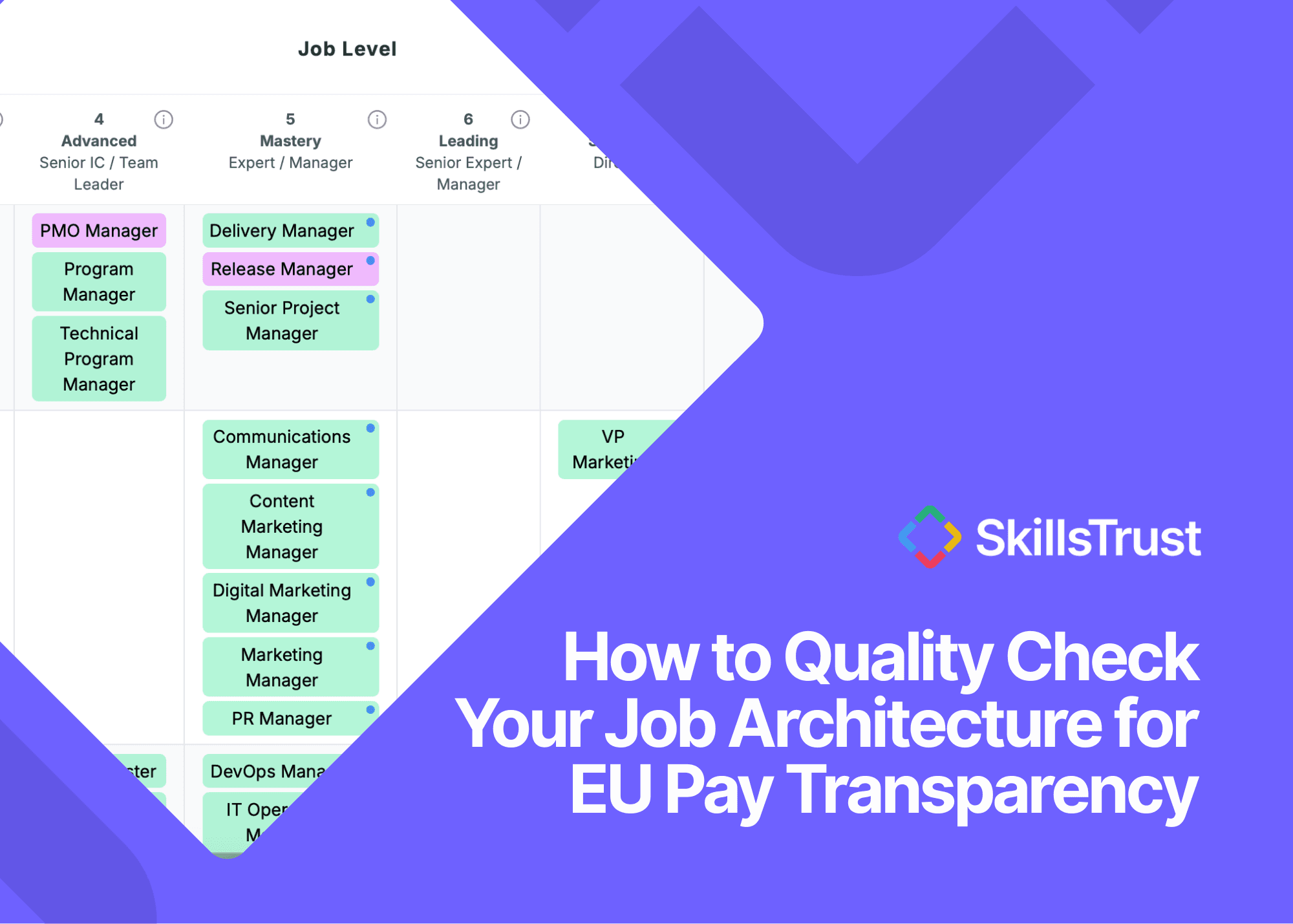
The effective date for the EU Pay Transparency Directive is fast approaching. For many HR teams, the past few months have been about building the foundations: creating job architecture from scratch and gaining visibility into initial pay gap analytics.
Reaching this point is a major milestone. But it also raises an important next question:
Is your job architecture fit for purpose?
Most organisations do not build a perfect job architecture on the first attempt. If you waited for perfection, it would never get off the ground. Deloitte’s annual job architecture survey shows that most projects take over six months to complete — and can stretch to two years or more.
Getting started often means launching a Version 1: a structure that helps everyone align on what job architecture is and how roles, levels, families and tracks are defined.
But having a version 1 does not automatically mean it is ready for primetime.
Under the EU Pay Transparency Directive, the job architecture is a critical compliance artefact. It will underpin future pay decisions, pay gap reporting, employee information rights, and conversations with employee representatives.
Before rolling it out broadly, it is worth putting your architecture through a set of quality checks to ensure it is consistent, defensible and easy to explain.
Based on our experience working with employers with 100 to 2,500 employees, here are four important questions to ask yourself about your current job architecture which will help you identify any weaknesses that may need to be addressed before rollout.
Q1. Can you comfortably explain how roles are evaluated?
1a. Does your job architecture map to the Directive’s factors?
Under the Directive, employers must be able to demonstrate that roles have been evaluated using objective, gender-neutral criteria, including skills, effort, responsibility and working conditions.
In practice, there are different ways to achieve this. You might use a quantitative point-factor methodology to categorise jobs. Or you might use a simpler job levelling structure, with level descriptions built around those same objective factors.
There is no single “right” way to build job architecture. But it must clearly tie back to objective criteria — and you must be able to explain how it works.
1b. Did you use a consistent method to map each role to a job category?
How were roles assigned to their job level and family? Can you demonstrate that roles across locations, entities and business units were categorised using the same approach? If challenged by managers, employees or works councils could you walk someone through the logic in a clear, structured way?
Read more about what a compliant job leveling framework looks like.
Q2. Can you evidence why each role sits where it does?
2a. Do you have a clear job title catalogue?
Do you have a clean job title inventory, or are duplicate or inconsistent titles creating unnecessary noise in the architecture? Job title inconsistencies can obscure pay disparities, make job evaluation harder, and weaken your compliance position under the EU Pay Transparency Directive.
Once job categories and pay gaps are mapped out, companies often notice a few patterns:
Different titles, same job: it’s common to find people with different job titles who are effectively doing the same work. For example, a ‘Customer Success Manager’ and a ‘Client Relationship Specialist’ might fall into the same category - even if the titles suggest different things.
Same title, different work: conversely, you might have people with the same job title whose work varies significantly - one might have more responsibility or manage a team, while another does not. This difference in scope will likely show up in the pay data.
Carrying out an exercise to standardise titles into a title catalogue now will save a lot of time when it comes to pay gap analysis. While there is no perfect benchmark, many organisations find that excessive title fragmentation (for example, fewer than five incumbents per title on average) creates noise and makes pay comparisons harder to defend.
Read more about why Job Titles matter for EU Pay Transparency (and what to do if yours are a mess).
2b. Do you have job content documentation for each role - or just assumptions?
What evidence supports the job level and job family assigned to each role?
Do you have a high-quality job description for every role, or are evaluations being made with limited documentation?
A “quality” job description clearly defines the current responsibilities, required skills and preparation, effort and working conditions of a role in an objective, gender-neutral way, so that the value of the work can be assessed.
Most organisations do not have robust job descriptions in place for all roles and in many cases, not even for the majority. To get started, many companies focus on having job descriptions in place for a subset of roles called anchor roles. The anchor roles are selected to represent a cross-section of the organisation across functions and seniority levels. By creating quality evidence for these roles, other roles are then slotted relative to the anchors.
This is a practical and sensible starting point. But over time, the architecture is far stronger when supported by documented job content for each role. A phased plan to document remaining roles is often the most realistic approach alongside other business priorities.
2c. Are you evaluating roles — not the people currently in them?
Have roles been evaluated based on job content, rather than the specific strengths or tenure of the individual currently in post?
Are there roles with a single incumbent that may have been levelled higher (or lower) due to an exceptional or long-tenured individual?
A helpful rule of thumb: if the person in the role left tomorrow, how would you evaluate the job for the next hire?
Job architecture should reflect the size and scope of the role, not the current individual(s).
Q3. How well does the structure hold up in practice?
3a. Are your job families structured logically?
Do you have a Goldilocks problem with job families?
If families are too big (for example, a single Corporate family covering HR, Legal, Facilities and Marketing), they may hide meaningful differences in work and group together roles that are not of equal value.
If they are too narrow, they may create artificial fragmentation between roles that are, in reality, of equal value. That creates risk if employees argue that their work is comparable to roles sitting in another family.
The right balance groups roles requiring similar types of skills, while remaining broad enough to support meaningful pay comparisons.
A useful litmus test is to ask yourself whether you can explain to an employee in under two minutes why certain roles sit together and where the boundaries of each family lie? If not, the structure may need refinement.
3b. Title splits across levels
Do you have roles with the same or similar job titles assigned across multiple levels? If so, can those distinctions be clearly justified?
This often arises with titles such as “Head of.” In some cases, the title applies to an individual contributor with limited scope. In others, it refers to a senior manager with a broad span of control.
In an ideal world, similar titles would sit at the same level. In reality, that is not always possible.
If your “Head of” roles span two or three levels, you need clear evidence showing how each role aligns to the framework definitions for its assigned level. Without that clarity, title consistency can quickly become a point of challenge.
3c. Title splits across job families
Are similar job titles appearing in multiple job families? If so, this is likely to raise employee questions.
Departments and business units are built around shared business goals. Job families, however, should group roles requiring similar types of skills to perform effectively.
For example, a Service Delivery department might include Engineers, Support Representatives, Analysts and Managers. But those roles may sit across different job families such as Engineering, Customer Support or Operations.
A single role can very often combine the need for functional skills and domain-specific skills/knowledge. The right job family for each role should align with the skills that are most critical for effective performance in the role.
For example, should a Financial Planning Analyst role sit in the Finance & Accounting job family or in Data & Analytics? Although the role requires skill in analytics tools and methods, it relies most heavily on accounting principles and financial acumen. It is not interchangeable with a general analyst. In most cases, it belongs in Finance & Accounting.
A helpful rule of thumb: if approximately 80% of effective performance depends on domain-specific skills rather than a general functional skillset, align the role to the domain job family.
Q4. Can you control what happens next with the job architecture?
4a. Stakeholder Review & Calibration Cycles
Before considering your job architecture ready for rollout, has it been sufficiently calibrated with stakeholders across the business to ensure it reflects how work is actually performed?
We typically expect that the V1 job architecture will be calibrated initially by the HR project team. This should include team members with sufficient tenure in the company/industry to understand the range of roles across the business. The next step is calibration with the executive team and functional business leads.
It is important to track the changes made to role levels during these calibration cycles. Upward-only movement during calibration may be a signal that the architecture is being used to negotiate status rather than reflect job size.
It is important to have guardrails in place to prevent stakeholders from “gaming” the architecture to elevate roles within their organisation. Proposed level changes should be supported by clear evidence against the framework definitions, with central oversight to ensure consistency.
4b. Governance and Future Changes
Your job architecture is a living artefact. It will evolve as new roles are introduced, business priorities shift, and legacy roles disappear.
The real question is not whether it will change, but whether those changes are well managed.
Without governance, job architecture drifts quickly. Titles multiply, level assignments creep upward, and exceptions proliferate. Over time, the structure becomes harder to explain and defend — particularly in a pay transparency environment where consistency matters.
To avoid this, start with a simple, one-page governance document that sets out:
Who is responsible, accountable, consulted and informed (RACI) when changes are proposed
What triggers updates (e.g. new role creation, reorganisations, material scope changes)
How often the architecture is reviewed at an organisational level
Who holds decision-making authority on job family and level assignments
What evidence is required to support a level change
Finally, consider how changes are documented. Maintaining a clear audit trail of role evaluations, level changes and calibration decisions will significantly strengthen your position if challenged by employees, employee representatives or regulators. The right tooling can also make governance easier to apply consistently.
With clear guardrails and disciplined change control, your job architecture remains stable, explainable and defensible - even as the organisation grows and evolves.
Conclusion
A Version 1 architecture is a strong starting point. But before broad rollout and certainly before relying on it for pay transparency reporting, it is worth stepping back and asking whether the structure is objective, explainable and defensible.
Small weaknesses in job categorisation, titling or governance can become amplified in a pay transparency environment. Putting the right quality checks and guardrails in place now will make your job architecture more reliable, easier to maintain, and far more defensible over time.
SkillsTrust provides software and advisory services that make pay transparency simple for EU employers. To learn more, book a free call.